e-mrtd
Java-based ePassport emulator implementing ICAO 9303 core protocols for issuance and verification flows.
Overview
e-mrtd is a Java-based electronic Machine Readable Travel Document (ePassport) simulator. It focuses on ICAO 9303 core protocol behavior and supports both educational use and integration testing.
Problem / Context
Smartcard and passport protocol workflows are hard to test repeatedly without controlled environments. I needed a reproducible setup to run personalization, authentication, and verification flows without relying only on physical cards.
What I built (your responsibilities)
- Implemented and maintained host-side flows that orchestrate issuance and verification.
- Worked on personalization handling for key LDS files including EF.COM, DG1, DG2, DG3, DG4, DG15, and EF.SOD.
- Added/used BAC and secure messaging tooling paths for end-to-end read/verify scenarios.
- Wired JavaFX launcher paths and command-line run scenarios for different test modes.
Architecture
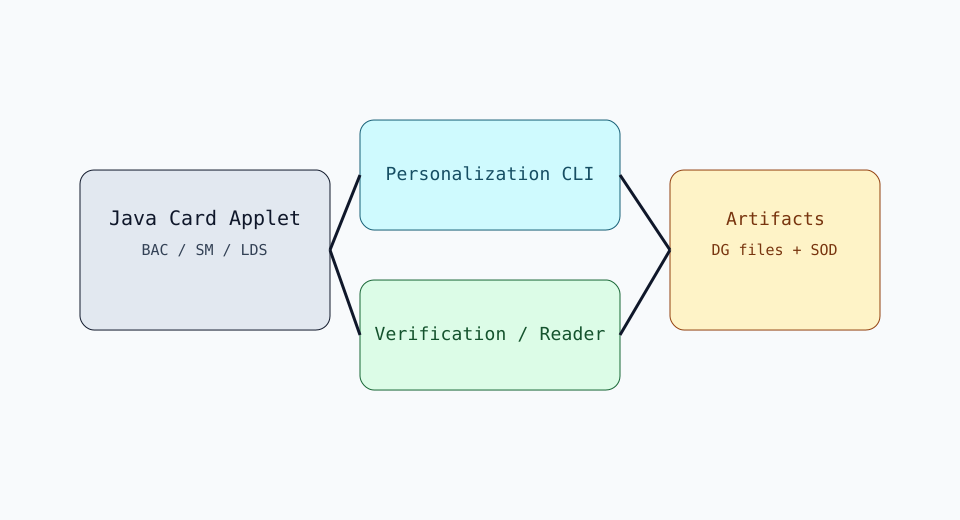
The project is structured around a Java Card applet simulation layer and host tools (emu) that drive personalization and verification scenarios. ReadDG1Main acts as the orchestrator for common issuance+verification runs.
Tech stack
- Java 17
- Maven
- Java Card applet model
- JavaFX (UI runner)
- BouncyCastle
Key challenges & solutions
- Challenge: Keeping protocol experiments reproducible. Solution: Added deterministic command-line scenario entry points and repeatable run commands.
- Challenge: Handling multiple data-group personalization paths. Solution: Structured personalization flow per LDS group and standardized generated artifacts.
- Challenge: Balancing simulator flexibility with security behavior realism. Solution: Kept BAC/secure messaging and passive-auth verification flows in the host toolchain.
- Challenge: Supporting both CLI and UI-driven workflows. Solution: Maintained JavaFX launch path while preserving CLI-first testing.
Outcomes / current status
The project remains active and currently includes broad LDS personalization coverage, BAC/secure messaging support, and scenario-oriented execution for development and testing.