sync-vector-engine
CRDT-based real-time synchronization engine spec for collaborative text state with vector-clock-aware playback.
Overview
sync-vector-engine is a CRDT-centric real-time synchronization project focused on text collaboration under unstable network conditions. The design treats the backend as the source of truth and uses event history to reconstruct state deterministically.
Problem / Context
Collaborative editing systems must handle concurrent writes, stale clients, and reconnect behavior without locking users out. The project explores how to keep consistency guarantees while preserving fast user feedback.
What I built (your responsibilities)
- Defined the synchronization model around raw WebSocket transport and delta broadcasting.
- Specified a custom sequence CRDT approach for deterministic character ordering.
- Added vector-clock-aware history rules for stale event merging.
- Designed snapshot + playback API behavior for time/operation-based state reconstruction.
Architecture
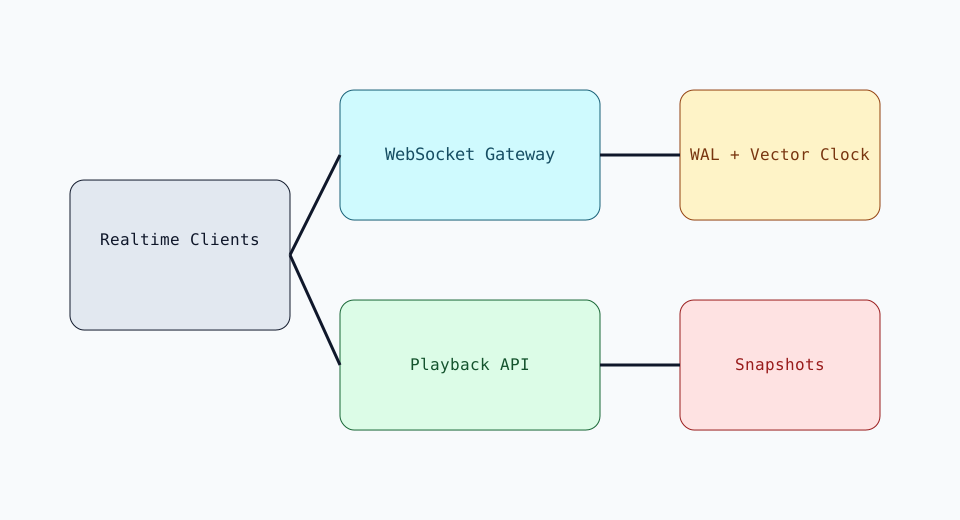
The design routes client deltas through a WebSocket gateway into an append-only operation log. Snapshot workers compact history, while playback endpoints rebuild state for requested operation or timestamp boundaries.
Tech stack
- Go or Rust (target language options in spec)
- Raw WebSocket server
- PostgreSQL append-only event log
- Redis for presence/pubsub
- Custom CRDT + vector clock model
Key challenges & solutions
- Challenge: Concurrent edits from multiple clients without central locking. Solution: Use sequence CRDT ordering and deterministic ID comparison rules.
- Challenge: Handling stale offline edits on reconnect. Solution: Track logical client clocks and merge based on vector history.
- Challenge: Avoiding unbounded memory/log growth. Solution: Introduce snapshot thresholds and replay from latest snapshot.
- Challenge: Reliability under load. Solution: Define strict non-functional targets for broadcast latency, concurrency, and WAL durability.
Outcomes / current status
Current repository state is specification-heavy and documents intended architecture and constraints in detail. It serves as a systems design blueprint for further implementation.